
Why does my safety switch keep tripping?
Because current is leaking to earth somewhere, and the switch is doing exactly what it was fitted to do. It isn't faulty and it isn't being fussy — it's reporting something. Below is how to narrow it down in about ten minutes without touching the board, the causes we find most often, and the point where you should stop resetting it and ring someone.
Get it found properly
Tell us what's tripping and when. The more detail, the faster we find it.
No call centre. Goes straight to us.
If it won't reset with everything unplugged, stop there
That means the leakage is in the fixed wiring, not an appliance. Leave it off and ring us.
Narrow it down yourself in ten minutes
None of this requires opening the switchboard, and none of it should. Everything here happens on the front of the board and at your power points. If at any stage something smells hot, looks burnt, or feels warm to the touch, skip the rest and ring us.
1. Look at which device moved
Is it the big switch marked RCD or "safety switch", a single small breaker, or the main switch? Take a photo of the board with your phone. That photo tells an electrician more than a paragraph of description.
2. Unplug everything on those circuits
Everything. Fridge, washing machine, dryer, dishwasher, chargers, the lot. Appliances with a plug, not hardwired gear. Turn off any outdoor and pool equipment at its own switch.
3. Reset it once
If it holds, the problem is plugged in somewhere. If it trips straight back off with nothing connected, it's in the wiring — stop here and leave it off.
4. Add things back one at a time
Plug one item in, use it, wait a few minutes. Then the next. Heating appliances are the usual offenders, so give kettles, dryers and dishwashers a full cycle rather than thirty seconds.
5. Write down the pattern
Does it only go at 11pm? Only after rain? Only when the dryer and the aircon are both on? The pattern is half the diagnosis and it's the half we can't see when we arrive.
6. Don't keep forcing it
Each reset puts voltage back onto whatever tripped it. One reset to test is fine. Ten is not, and taping or jamming a switch up is how people get hurt.
A safety switch and a circuit breaker trip for different reasons
Worth knowing, because which device moved narrows the cause enormously — and because people often describe one and mean the other.
- A safety switch (RCD) compares the current flowing out on the active with the current returning on the neutral. If they differ by around 30 milliamps, some of it is going somewhere else — through earth, through water, or through a person — and it disconnects in well under a second.
- A circuit breaker (MCB) doesn't care about leakage. It trips on too much current: an overload, or a dead short. That's a wiring-protection device, not a life-protection device.
- An RCBO is both in one module, on one circuit. That's what we fit per circuit when we replace a board, and it's why a fault then takes out one circuit instead of the house.
- Fuses do neither. A ceramic rewireable fuse protects the cable and nothing else. If that's what's in your board, there is no shock protection in the house at all.
So: safety switch tripping means leakage, and we go looking for moisture, failing elements and damaged cable. A single breaker tripping means current, and we go looking for overload or a short. Two different jobs.
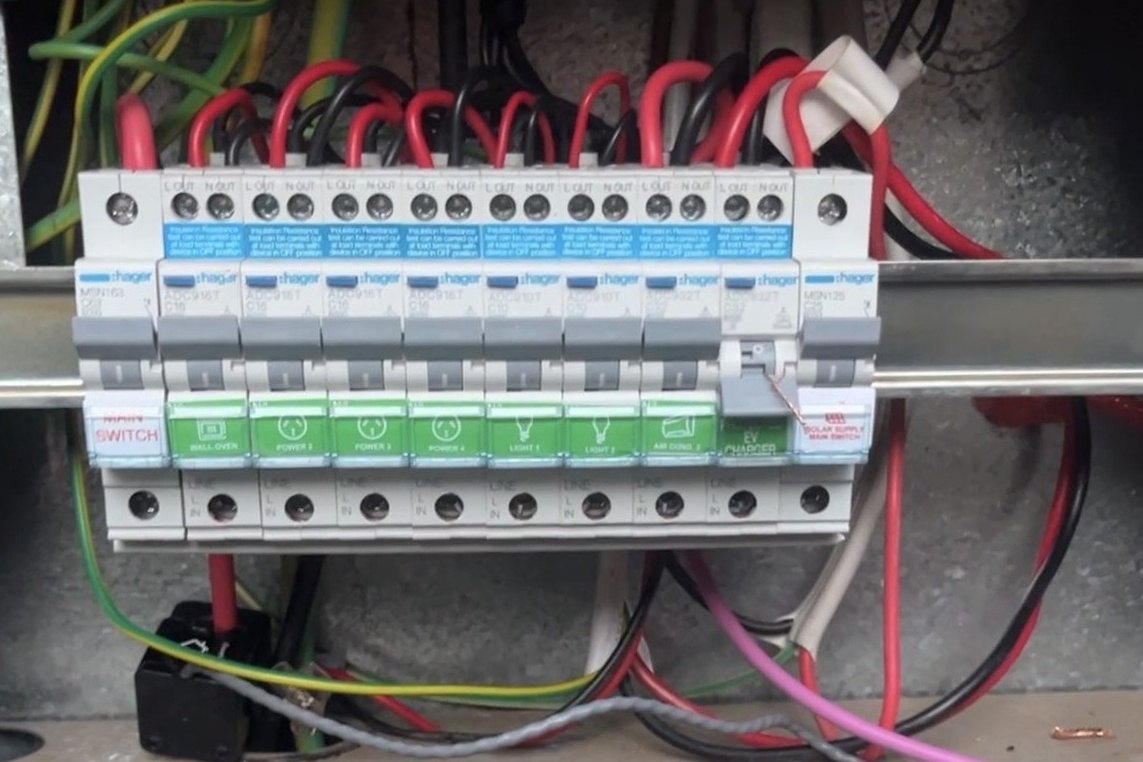
What we actually find
Roughly in order of how often it turns out to be the answer. Nearly all of these are real faults rather than nuisances — the switch is right and something does need fixing.
Water where it shouldn't be
Outdoor power points, pergola and garden lighting, joints sitting in a damp pit, pool and spa gear, water in a conduit. Tripping that follows the weather is nearly always this.
A failing hot water element
Classic overnight tripping. The element only leaks while it's heating, so the trip happens on the controlled-load window and everything looks fine in the morning.
A heating element in an appliance
Dishwasher, washing machine, dryer, oven, kettle. Elements fail by going slightly leaky before they fail completely, which is the exact condition an RCD is built to catch.
An old fridge or freezer
Especially one going into a defrost cycle, and especially a second fridge in the garage. Tripping at seemingly random intervals with nobody home points here.
Accumulated standing leakage
Every switchmode power supply leaks a tiny amount to earth by design. Twenty of them on one shared RCD can sit close to the threshold, so one more device tips it over. Common in houses with one safety switch for everything.
Downlight transformers and LED drivers
Nineties halogen transformers cooking under insulation, and cheap LED drivers failing early. Usually shows as one lighting circuit misbehaving and nothing else.
A screw or nail through a cable
A picture hook, a decking screw, a TV bracket, a plumber's clip. Starts right after somebody did work on the house, which is the giveaway.
Rodent damage in the roof
Chewed insulation on a cable in the roof space or subfloor. Often intermittent, often seasonal, and the reason we end up in the roof rather than at the board.
Wiring faults from past work
A neutral touching earth, or two circuits sharing a neutral from an earlier alteration. These trip with everything unplugged, which is how we know to look here.
Solar is worth a mention. A faulty inverter or a DC-side fault can show up as unexplained tripping, and some RCD types are more sensitive to it than others. If you've got solar and the tripping started without any other change, say so when you ring.
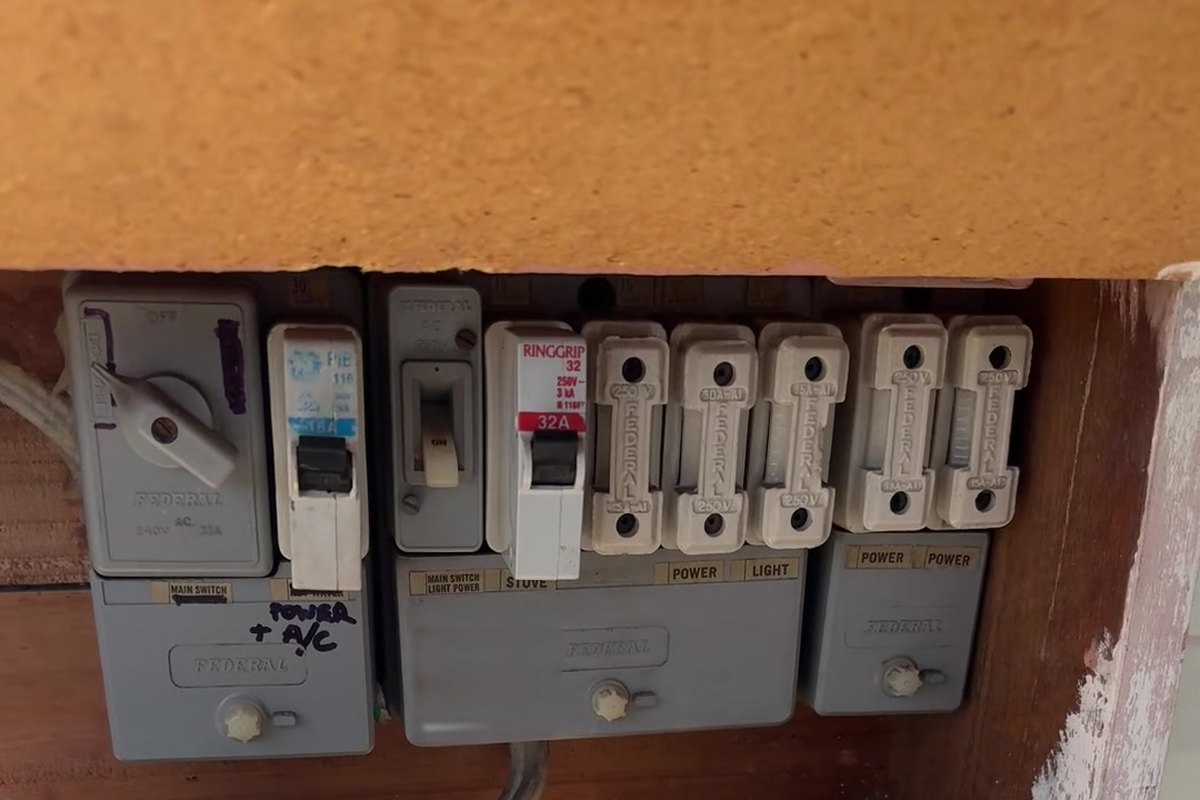
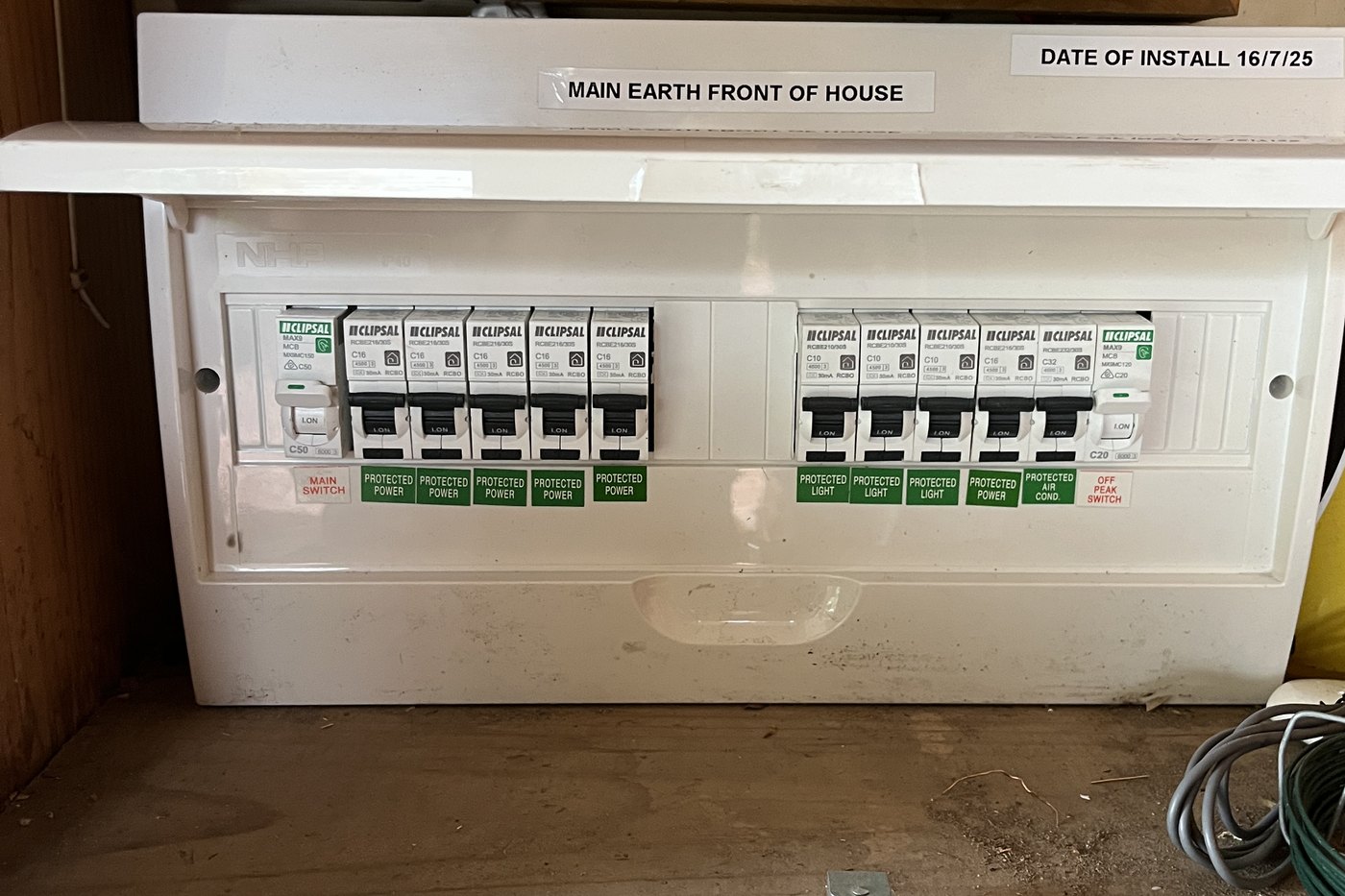
Why one small fault blacks out your whole house
If a single failing appliance takes out your lights, your fridge and your internet all at once, the appliance is only half the story. The other half is the board.
- One shared RCD for everything was standard practice through the late eighties and nineties. Every power circuit sits behind one device, so any one of them can drop all of them.
- Lighting often left unprotected on those same boards — which is the circuit you're most likely to be working on when you change a fitting.
- Standing leakage stacks up behind a shared device as a house accumulates electronics, so it gets twitchier over time with nothing actually breaking.
- Diagnosis is slower and therefore dearer, because the fault could be anywhere behind that one switch rather than on one identified circuit.
- An RCBO per circuit fixes all four. One fault, one circuit, immediately obvious which one, and the rest of the house stays on.
When it stops being a nuisance and becomes urgent
Anything hot, burnt or smelling
A warm switch plate, a scorch mark, or that acrid smell around the board or a power point. Turn the circuit off and ring. This one doesn't wait until Monday.
A tingle off a tap or appliance
Any sensation off a metal tap, shower fitting, oven or washing machine means a live fault. Stop using it, don't touch it wet, and ring immediately.
It trips the instant you reset it
With everything unplugged, that's a fault in the fixed wiring. Leave it off. Resetting onto it repeatedly is the version of this that goes badly.
It's getting more frequent
Weekly, then daily, then hourly is a fault that's deteriorating. It won't settle down on its own, and it's cheapest to find while it's still intermittent.
No safety switch in the board at all
If you've got rewireable ceramic fuses and nothing else, there's no shock protection in the house. Nothing is "tripping" because nothing is watching. That's a board replacement conversation.
It's a rental
Repeated tripping in a rental is a repair obligation, and it's also exactly what a two-yearly electrical safety check exists to catch. Rental providers: get it recorded and fixed, not reset.
Measured, not guessed
The reason "we'll just replace the safety switch and see" costs you twice is that it doesn't find anything. Here's the actual process.
Test the device itself
Trip current and trip time measured with an instrument, so we know whether the RCD is within spec before we blame anything downstream.
Measure leakage per circuit
Circuits separated and leakage measured on each one, live. That gives a number per circuit rather than a theory, and it finds standing leakage that intermittent faults hide behind.
Insulation resistance where needed
For a fault in the fixed wiring, the circuit is isolated and tested properly — which is how damaged cable in a roof space gets located instead of guessed at.
Find it, then price the fix
You get told what it is and what it costs to repair before we start repairing. Diagnosis and repair are two separate decisions and you make both.
Questions we get asked
Why does my safety switch keep tripping?
Because current is leaking out of the circuit to earth instead of returning through the neutral. A safety switch, or RCD, measures the difference between what goes out and what comes back and disconnects when that difference reaches around 30 milliamps. That leakage is usually a failing appliance, water where it shouldn't be, or damaged cable. The switch isn't faulty — it's reporting something.
What's the difference between a safety switch and a circuit breaker?
A circuit breaker protects the wiring against overload and short circuit. A safety switch protects the person against electric shock by detecting leakage to earth. They trip for completely different reasons, so which device moved tells an electrician a lot. An RCBO is both functions in one module, which is what we fit per circuit on a switchboard upgrade.
How do I find out which appliance is causing it?
Unplug everything on the affected circuits, reset the switch, and if it holds, plug items back in one at a time and wait a few minutes between each. The one that trips it again is your culprit. If it won't hold with everything unplugged, the problem is in the fixed wiring rather than an appliance — and that's the point to stop and ring an electrician.
Is it safe to keep resetting the safety switch?
No. Each reset re-energises whatever the switch disconnected from, and if that's a damaged cable or a wet fitting, you're putting voltage back onto it. One reset to see whether it holds is reasonable. Repeatedly forcing it back on, or holding it up, is not. If it won't stay on, leave it off and ring someone.
Why does it only trip when it rains?
Water is the most common cause of leakage. Outdoor power points, pergola and garden lighting, joints in damp pits, pool and spa equipment and water in a conduit will all raise leakage enough to trip a 30 mA device. Tripping that follows the weather almost always points outside — and it's a genuine fault rather than a nuisance, even though it clears when things dry out.
Why does it trip in the middle of the night?
Something on a timer is the first suspect: an electric hot water service on a controlled load, a pool pump, irrigation, or a fridge or freezer going into a defrost cycle. A failing hot water element is one of the most common causes of overnight tripping we find, because the element only draws current when it's heating.
Can a safety switch itself go faulty?
It can, but it's well down the list. RCDs do age and some older devices become over-sensitive or slow. We test trip current and trip time with an instrument rather than assume, because replacing the device when the real problem is a leaking circuit just moves the fault somewhere less obvious.
Why does one fault take out the whole house?
Because the board has one shared RCD covering every power circuit, which is how boards were commonly built through the late eighties and nineties. Everything downstream shares that one device, so one failing appliance drops the lot — including the fridge and the lights. Replacing the board with an RCBO on every circuit confines a fault to one circuit.
My lights aren't protected at all. Is that legal?
An older installation is generally allowed to stay as it was wired at the time, so an existing house with no RCD on the lighting circuits isn't automatically illegal. New and altered work has to meet the current Wiring Rules, which require RCD protection on final subcircuits in domestic installations. In practice, if we're touching those circuits they get brought up to standard.
Where we work
Pakenham and Surrounds.
Core — same or next day
- Pakenham
- Officer
- Beaconsfield
- Berwick
- Narre Warren
- Cardinia
Regular — usually within the week
- Cranbourne
- Clyde & Clyde North
- Drouin
- Warragul
- Emerald & Cockatoo
- Hallam
By arrangement
- Dandenong
- Frankston
- Phillip Island
Get it found properly
Tell us what's tripping and when, and we'll come and measure it rather than guess at it.