
What changes the price of a switchboard upgrade
Two houses in the same street can be thousands apart on the same job. It isn't the brand of the breakers. It's what's behind the board, what condition the mains are in, and how many circuits have to end up protected. Here's each thing that moves the number, so you can work out roughly where you sit before anybody turns up.
Get a fixed quote
Send a photo of the open board if you can. It tells us more than a description does and saves a trip.
No call centre. Goes straight to us.
Where the money actually goes
Roughly in order of how much they swing the price. The first four are the ones that separate a one-day job from a two-day job with an inspector booked.
1. How many circuits end up protected
This is the main one. Every circuit that gets its own RCBO is a device, a connection and a test. A small older house might have six circuits. A double-storey with ducted heating, aircon, a pool and a shed can be well over twenty. Count the switches on your existing board and you're close.
2. What's behind the board
Boards fitted before the mid-eighties are often mounted on a sheet containing asbestos. It can't be drilled or cut, removal is licensed work with its own disposal, and it is the single biggest step-up in price on an old board. Sometimes the cheaper answer is to leave it undisturbed and mount clear of it.
3. The condition of the consumer mains
The cable from the street or the pole to your board. If it's undersized, brittle, heat-damaged or spliced, it gets replaced and that's a separate piece of work with its own cost. If it's sound and big enough, it stays. Plenty of houses don't need theirs touched.
4. Whether the work is prescribed
Some work in Victoria must be independently inspected by a Licensed Electrical Inspector before the Certificate of Electrical Safety is issued. Switchboard and mains work often is. That's a real cost and a real booking. It belongs in the quote, not in a phone call afterwards.
5. The enclosure and where it's mounted
A bigger enclosure costs a little more and buys you spare ways. Outdoors needs a sealed weatherproof enclosure. A board in a hallway cupboard, under a stairwell, behind a door that won't open past it or at the back of a built-in robe takes longer for the same end result.
6. Whether the meter panel has to be rearranged
On older installations the meter, the main switch and the circuits are crowded onto one panel with no room to work. Separating them properly, or shifting the board to a better position, adds work. It also often fixes the real problem, which is that there was never anywhere to put anything.
7. The point of attachment and the supply
If the overhead service is old, low, or attached to something that shouldn't be holding it, it comes into scope. Anything involving the distributor's side of the connection means their timeframe, not ours, and sometimes a second visit.
8. Temporary supply and isolation
The power is off for most of the day. Most houses just plan around it. A home business, a tenant who works from home, medical equipment or a full freezer can mean temporary arrangements or staging the work, which costs more than doing it in one hit.
9. What you add while the cover is off
Surge protection, spare ways for an EV charger or battery, a labelled circuit schedule, smoke alarm circuits, fixing the circuit that was never right. Each one is cheap now and expensive as its own visit later.
What's not a real cost driver: the brand on the breakers. Any reputable manufacturer's RCBO protects you the same way. The money on a switchboard job goes into labour, circuit count and what we find behind the board — not the name on the devices.
How to tell roughly where you sit
You don't need to open anything or touch anything. The front of the board and the age of the house tell you most of it.
Likely the cheaper end
- House built from the mid-nineties on, so no asbestos backing sheet
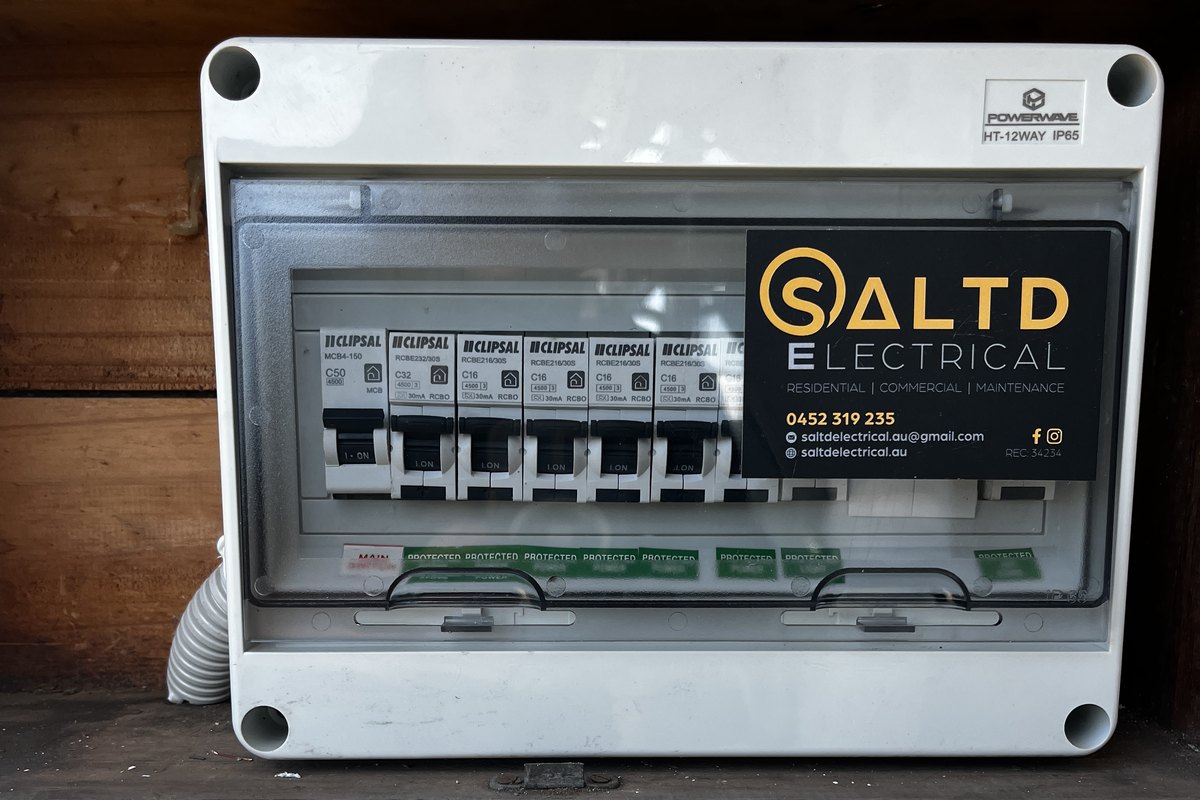
- Modern plastic enclosure with a hinged cover, mounted somewhere you can stand in front of
- Under about a dozen circuits
- Meter is separate from the circuits, with room to work
- Mains look sound and were sized for a house of that size
- Nobody needs to be involved beyond us
Likely the dearer end
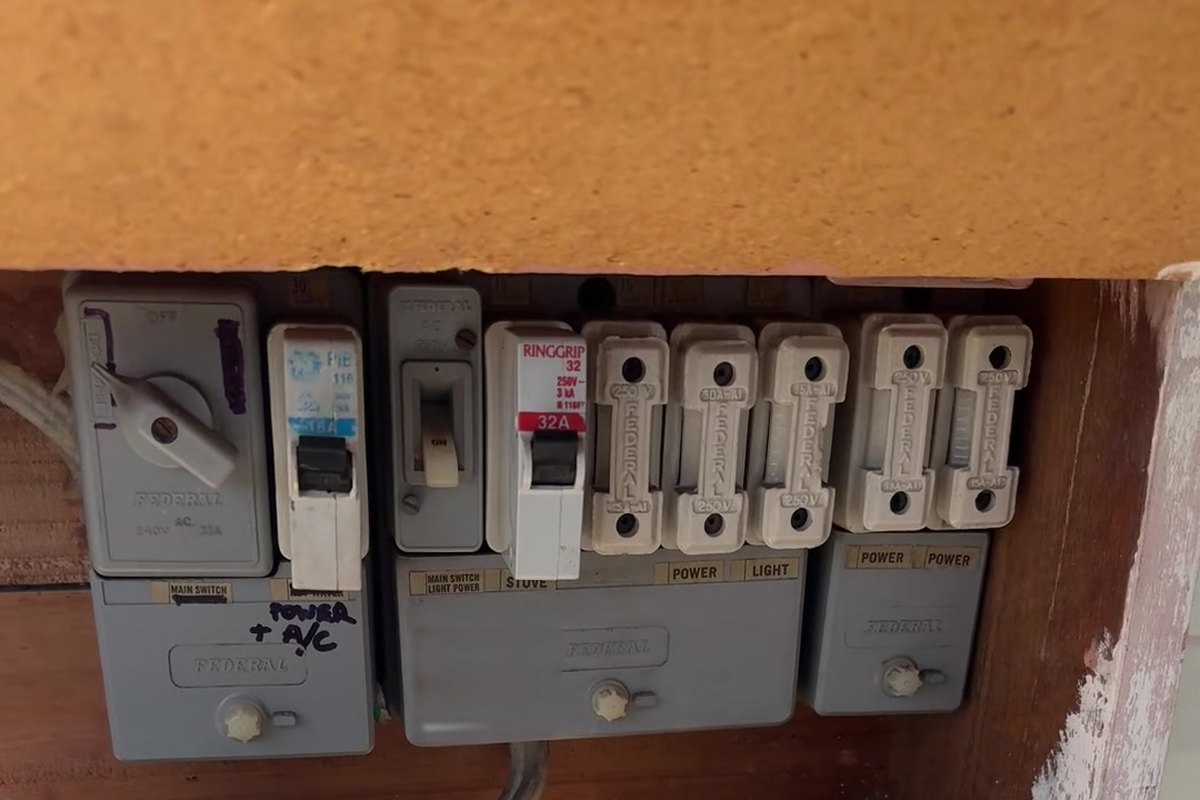
- Ceramic fuses, or a grey metal board, or anything pre-1985
- Board mounted on a flat grey or off-white sheet that looks like fibro
- Twenty-plus circuits, ducted heating and cooling, pool, shed, pump
- Meter, main switch and circuits all crammed onto one panel
- Overhead service that's old, sagging, or attached to a private pole
- Mains that are visibly discoloured, brittle or have been joined
Don't take the cover off to check. A photo of the closed board, plus the rough age of the house, is enough for us to give you a ballpark on the phone.
One safety switch is cheaper. It's also the worst one to live with
The lowest quote you'll get is a single RCD fitted in front of everything. It's legal, it's quick, and it's how a lot of nineties boards were done. It's also why one failing kettle element takes out your lights, your fridge and your internet at the same time.
- One RCD for the house — cheapest on the day. Any fault anywhere blacks out everything, and finding it means trial and error in the dark.
- An RCBO per circuit — dearer up front. A fault isolates to one circuit, the rest of the house stays on, and the board tells you where to look.
- Standing leakage adds up — every switchmode power supply in the house leaks a tiny amount. Pool them all behind one device and it trips on nothing in particular. Split them up and it doesn't.
- Sometimes you don't need a new board — if the existing enclosure has spare ways and the circuits are in good order, RCBOs can go in without replacing it. We'll say so if that's the case.
Why one small fault blacks out the whole house goes into this properly.
Six things we spell out before you decide
A switchboard quote is a number attached to a scope, and the scope is the part that matters. Here's what ours says, so you know exactly what you're agreeing to.
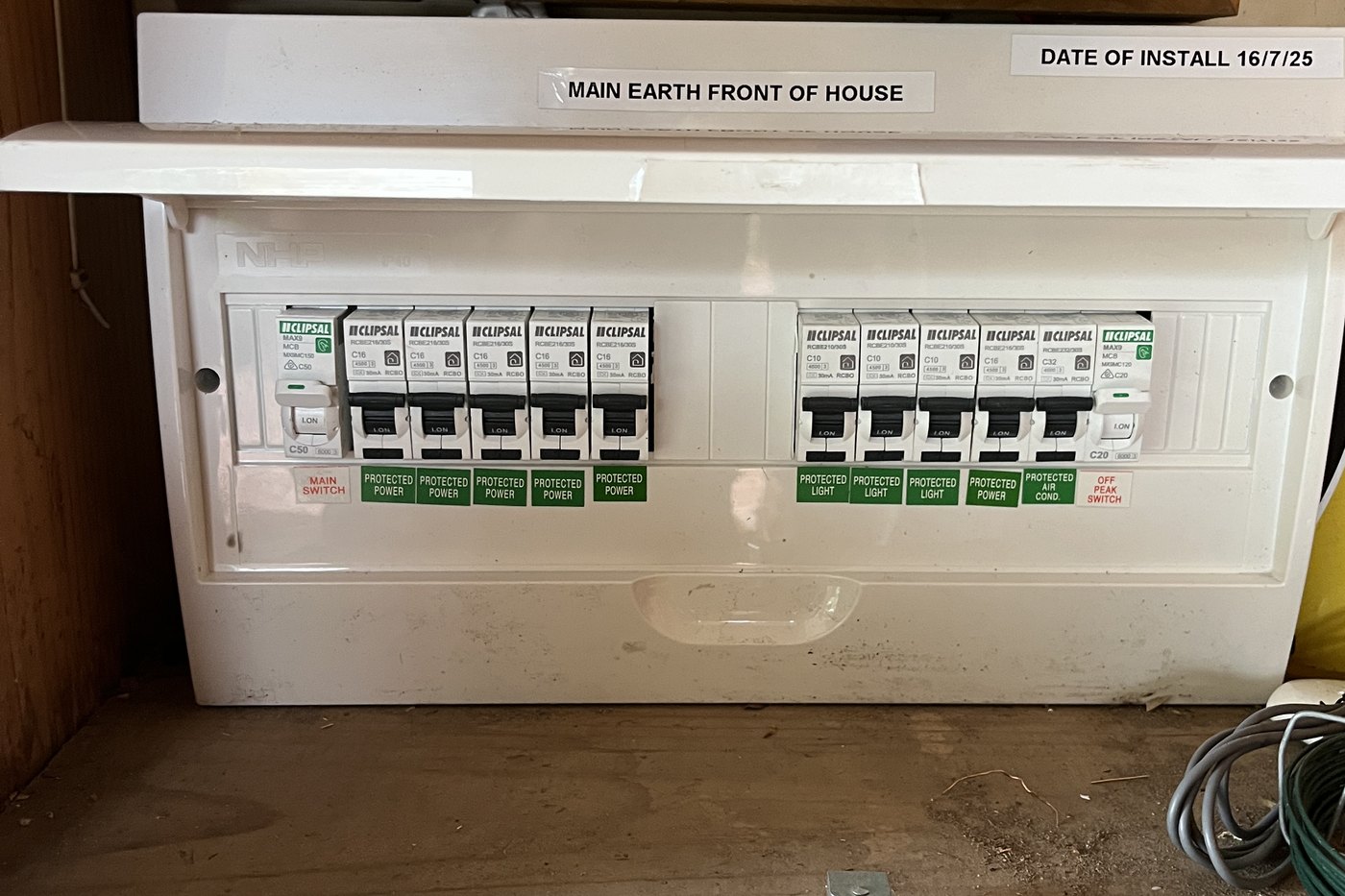
How many RCBOs, and on what
Every circuit listed, and what protects it. Individual RCBOs per circuit rather than one RCD shared across several, and the schedule written down so you can see it.
Whether the inspection is included
If the work is prescribed, a Licensed Electrical Inspector has to sign it off before the Certificate of Electrical Safety issues. When that applies, it's in our price, not added later.
Whether the consumer mains are in, and why
If we're replacing them we tell you the reason — undersized for the load, damaged, or heat-affected at the terminations. If they're fine, we leave them and say so.
How we're handling asbestos if it's there
On a pre-1985 board we check the backing sheet before quoting, because it's the single biggest step-up in price and the worst thing to discover mid-job.
How many spare ways you're left with
An actual number, not "room to grow". A board that's full the day it's finished is a board you pay to open again for the EV charger, the battery or the aircon.
That it's a fixed price, not an estimate
Fixed in writing once we've seen the board. If something genuinely unforeseeable turns up behind it, you hear about it before we do the work, not on the invoice.
Spare capacity is the cheapest thing on the quote
A board gets replaced roughly once in a generation. What the house wants over the next ten years is already fairly predictable, and making room for it while the cover is off costs very little.
An EV charger
A dedicated circuit and the right kind of RCD. Often no supply upgrade needed at all — whether you actually need a switchboard upgrade for an EV charger covers when you do and when you don't.
Solar and a battery
A battery retrofit wants room at the board and, if you want backup circuits, somewhere for a backup sub-board. Easy now, awkward later. See home batteries.
Aircon, a reno, a shed
Ducted or split systems, a kitchen rewire, a shed sub-board. All of them want ways. Two spare ways cost almost nothing; a second board visit doesn't.
If the board's being done anyway, the related work is worth looking at in the same quote — switchboard upgrades, consumer mains, single to three-phase. Three visits cost meaningfully more than one.
Questions we get asked
How much does a switchboard upgrade cost?
It depends on how many circuits are being protected, whether the existing enclosure and backing sheet can stay, the condition of the consumer mains, and whether the work is prescribed and needs independent inspection. A straight board swap on a modern enclosure with a handful of circuits sits at the bottom. An old board on an asbestos backing sheet, with tired mains and a meter panel that has to be rearranged, sits at the top. We quote a fixed price after looking at the board rather than over the phone, because the two jobs aren't close.
Why can't you quote a switchboard upgrade over the phone?
Because the two biggest cost drivers can't be seen from a description — what's behind the board, and what condition the consumer mains are in. A photo of the board gets us most of the way there and we're happy to give you a ballpark off one before anybody drives anywhere. The fixed price comes after we've seen it.
Does an asbestos backing sheet make it more expensive?
Yes, noticeably. Boards from before the mid-eighties are often mounted on a sheet containing asbestos. It can't be drilled or cut, and removal is licensed work with its own disposal requirements. Sometimes the cheaper answer is to leave the sheet undisturbed and mount a new enclosure clear of it. We check for it before quoting, not during the job.
Do I need to upgrade the consumer mains at the same time?
Not always, and it's worth establishing before you agree to it. Undersized, brittle or heat-damaged mains need replacing. Mains that are sound and big enough for the load don't. A new board on tired mains is a job half done — but a mains upgrade on a house that doesn't need one is money spent for nothing. If a quote includes one, ask why.
How long does a switchboard upgrade take?
Most residential boards are a day. The power's off for a good part of it, so plan around the fridge, anyone working from home and medical equipment. Where the meter panel has to be rearranged, the point of attachment is involved, or the distributor has to disconnect and reconnect, it can run to two days or need a separate visit.
What is prescribed electrical work and why does it affect the price?
Certain work in Victoria is classed as prescribed and has to be independently inspected by a Licensed Electrical Inspector before a Certificate of Electrical Safety is issued. Switchboard and consumer mains work frequently falls into it. The inspection is a real cost and a real booking in the calendar. It should be in the quote, not sprung on you afterwards — and the certificate is yours to keep.
Is it cheaper to add a safety switch than replace the whole board?
On the day, yes. Over the life of the house, usually not. Adding one RCD in front of everything is the cheapest fix and the worst outcome to live with, because a single fault anywhere then blacks out the whole house. If the board has room and the circuits are in good order, individual RCBOs can sometimes be fitted without a full replacement. If it has no room, you're paying twice to end up where a replacement would have put you.
Should I leave room for an EV charger or a battery?
Yes, and it costs very little at the time. Spare ways in a larger enclosure are cheap while the cover is already off and expensive once the board is full. A board replaced now with no spare capacity gets opened up again for the first EV charger, the battery or the ducted aircon, and three visits cost meaningfully more than one.
Do you charge for the quote?
No. We look at the board, tell you what it needs and what it doesn't, and give you a fixed price in writing. If the honest answer is that your board's fine and you only need one circuit changed, that's what we'll tell you.
Where we work
Pakenham and Surrounds.
Core — same or next day
- Pakenham
- Officer
- Beaconsfield
- Berwick
- Narre Warren
- Cardinia
Regular — usually within the week
- Cranbourne
- Clyde & Clyde North
- Drouin
- Warragul
- Emerald & Cockatoo
- Hallam
By arrangement
- Dandenong
- Frankston
- Phillip Island
Get a fixed price on your board
No charge to look at it. If it doesn't need replacing, we'll tell you that instead.