
Electrical fault finding, measured not guessed
Dead circuits. Power that comes and goes. Lights that stopped working on their own. An outlet that's gone dead. A smell you can't place. We test and measure until we know what it actually is, tell you the cause and what the repair costs, and then fix it. The attendance and diagnosis fee is told to you before we book, so there's no open-ended hourly rate running in the background.
Get the fault found
Tell us what stopped working and when it started. Detail saves us both time.
No call centre. Goes straight to us.
Smell something hot, or felt a tingle off a tap?
Switch that circuit off at the board if you safely can, stop using it, and ring. This one doesn't wait.
The faults we get called to
Most calls land in one of these. If yours isn't here, ring anyway — it's still almost certainly us.
Part of the house dead
One room, one side of the house, or everything on one circuit. Usually a tripped breaker, a shared safety switch that's dropped out, or a connection that's failed somewhere along the run.
The whole house dead
First question is whether the street is off too. If it's only you and the main switch is still up, the problem is on your side of the connection point, and a lost neutral is the one we take most seriously.
Power that comes and goes
Works, then doesn't, then works again. That's a connection heating up and letting go, and it's the fault we most want to see sooner rather than later.
Dead power points
One outlet, or a run of them. Points are wired through from one to the next, so a single failed connection takes out everything downstream of it.
Lights out, flickering or dimming
A circuit that's gone dark, downlights that flicker, lights that dip when the oven or the aircon starts. Three different causes, and they're told apart by measuring, not by looking.
Hot water not heating
Electric storage services run on a controlled load, so nobody notices until the shower goes cold. It's a failed element, a failed thermostat, or no supply arriving — and we find out which before replacing anything.
Oven, cooktop or appliance dead
Hardwired appliances fail at the isolator and the connection as often as they fail internally. Worth having checked before you're sold a new oven.
Sheds, garages and outdoor circuits
Submains to a shed, garden lighting, pool and irrigation gear. These live outside in the weather, which is why they fail first and why they're the most common source of leakage.
Heat, smell or scorch marks
A warm switch plate, discolouration around a power point, that acrid smell near the board. That's a fault already doing damage. Turn it off and ring.
If it's specifically the safety switch dropping out, the diagnosis runs differently — that's leakage to earth rather than a broken connection. Start with why a safety switch keeps tripping, including what you can narrow down yourself in ten minutes before ringing anyone.
Work out whose fault it is first
The distributor owns the network up to your connection point. Everything from there into the house is yours. Five minutes on this can save you a call-out fee, and we'd rather tell you than charge you to find out.
- Are the neighbours off? If the street is dark it's the network, and AusNet or United Energy — whichever covers your street — will have it on their outage page.
- Is your main switch still up? If it's tripped, something in the house did that. Put it back on once. If it won't stay, leave it off.
- Only your house, main switch on, nothing? That's either the service fuse or your consumer mains. The fuse is theirs; the mains are yours.
- Lights dipping and brightening, or burning out early? Stop and ring immediately. That pattern can mean a neutral problem on the supply, and it damages appliances while it's happening.
- Photograph the switchboard before you touch it. Which device moved is half the diagnosis, and once it's been reset six times nobody can tell.
If it turns out to be the distributor's, we'll tell you to ring them rather than inventing work. And if we're already on site when we find that out, you're not charged for the repair we didn't do.
Tested, in an order that narrows it down
The reason "we'll replace that and see" costs you twice is that it doesn't find anything. Fault finding is a process of halving the possibilities until one is left, and every step produces a number rather than an opinion.
1. Start at the board
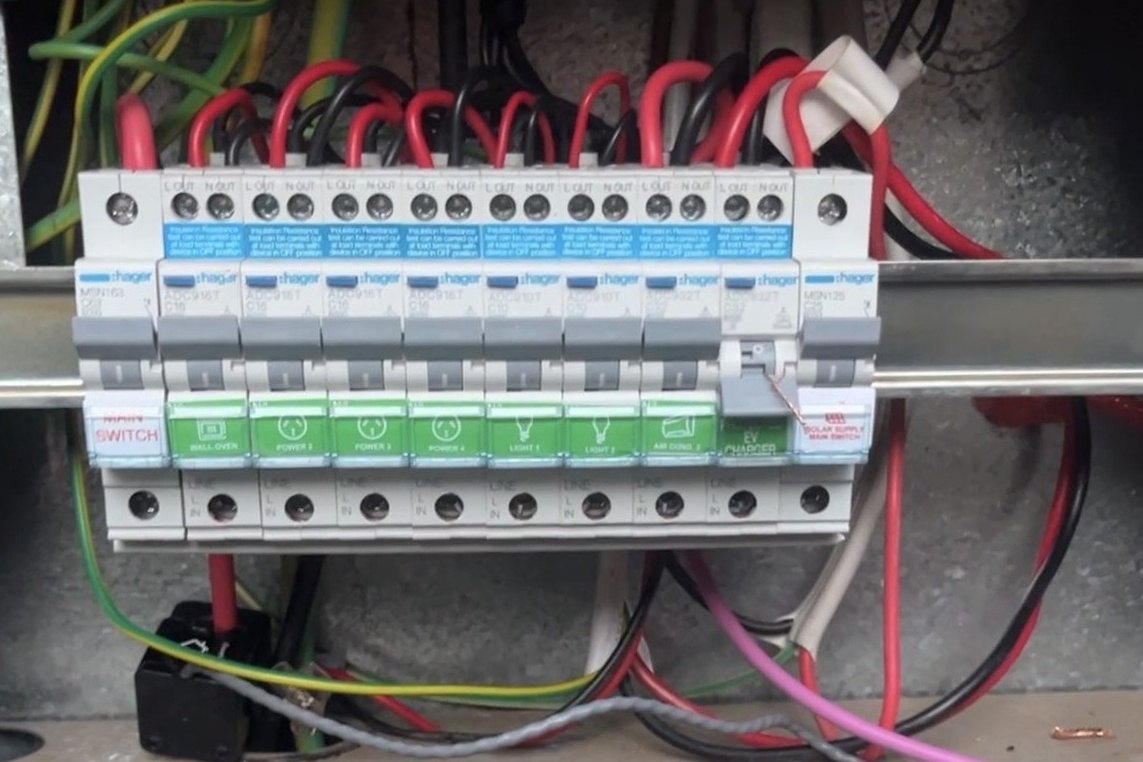
What's tripped, what's still on, what's actually feeding what. On an unlabelled board that means identifying the circuits first, which is work that pays for itself the moment anything else ever goes wrong.
2. Confirm supply and polarity
Voltage and polarity checked at the board and at the far end of the circuit. A reversed or broken neutral from earlier work explains a surprising number of strange symptoms.
3. Divide the circuit
The run gets split at an accessible point and each half tested separately. Two or three rounds of that puts the fault between two known points instead of somewhere in the house.
4. Insulation resistance and continuity
Circuit isolated and tested properly. That's how damaged cable in a roof space or a nail through a wall cable gets located rather than theorised about.
5. Load it and check for heat
Plenty of faults only appear under load. We put current through the circuit and check terminations for heat, because a loose connection is cool and innocent until it's working.
6. Find it, then price the fix
You get told what it is and what repairing it costs before any repairing starts. Diagnosis and repair are two decisions and you make both.
Intermittent faults are the awkward ones, because a fault has to be present to be measured. If yours only happens at 6pm, or only in the rain, or only when the dryer's going, say so when you ring — we'll book a time that gives us a chance of catching it rather than turning up while it's behaving.
What it normally turns out to be
Broadly in order of how often it's the answer. Almost all of these are a connection somewhere that's stopped being a connection.
A loose terminal screw
In a power point, a switch, a light fitting or the board itself. Heats, expands, loses contact, cools, makes contact again. The single most common cause of intermittent power there is.
Push-in terminals letting go
Spring terminals that were never quite right, usually in an accessory that's been in and out of the wall a few times. Common in a house that's had a renovation and a repaint.
A broken or shared neutral
A neutral that's come adrift, or two circuits that were joined onto one neutral during earlier work. Produces symptoms that look impossible until the board is tested properly.
A screw or nail through a cable
Picture hook, decking screw, TV bracket, plumber's clip. The giveaway is that it started right after somebody did work on the house.
Rodent damage in the roof
Chewed insulation on a cable in the roof space or subfloor. Often intermittent, often seasonal, and the reason we end up above the ceiling rather than at the board.
Water in the wrong place
Outdoor outlets, garden lighting, joints in a damp pit, water tracking down a conduit. Faults that follow the weather are almost always out in it.
A failed element or motor
Hot water elements, oven elements, pool and spa pumps, old fridges. Elements mostly fail gradually, which is why they're found by measuring rather than by looking.
Downlight transformers and drivers
Nineties halogen transformers cooking under insulation, and cheap LED drivers failing early. Usually shows up as one lighting circuit misbehaving and nothing else.
An overloaded circuit
A breaker doing exactly its job because too much has been added to one circuit over the years. The fix is a new circuit, not a bigger breaker, and anyone who offers you a bigger breaker is the problem.
Two numbers, and you decide at the gate
Fault finding is the one job nobody can quote a fixed total on before seeing it, because the cause is the thing you're paying us to find. So it's split in two and you approve the second half.
- Attendance and diagnosis — a set fee, told to you when you book, not after
- Then a fixed price to repair it — quoted once we know what it is
- Nothing happens on assumption — you say yes before the repair starts
- No second call-out fee if we have to come back with a part
- Small jobs welcome — one dead outlet is a legitimate call, not a nuisance
- Certificate of Electrical Safety on completion, every time
Rental providers and agents: a fault report is a repair obligation, and repeated faults are exactly what the two-yearly electrical safety check exists to catch. We invoice and document in a way that suits the agent and the owner.
Faults that shouldn't wait until Monday
Anything hot or discoloured
A warm switch plate, a brown mark around an outlet, heat you can feel through the board cover. Something is arcing. Switch that circuit off and ring.
A burning or fishy smell
Overheating plastic has a distinct acrid smell and it doesn't come from nowhere. If you can smell it near the board or a fitting, that's not something to air out.
A tingle off a tap or appliance
Any sensation off a metal tap, shower fitting, oven or washing machine means a live fault. Stop using it, don't touch it wet, ring straight away.
Lights brightening and dimming
Especially across the whole house, and especially with globes failing early. Can indicate a neutral problem on the supply, which damages appliances the whole time it's happening.
Sparks or a bang at a point
A flash and a pop when something was plugged in isn't a one-off to be shrugged at. Leave that circuit off until it's been looked at.
It's getting more frequent
Monthly, then weekly, then daily is a fault deteriorating. It won't settle down on its own, and it's always cheapest to find while it's still intermittent.
Questions we get asked
What does electrical fault finding cost?
It's charged in two parts. A set attendance and diagnosis fee, which you're told before we book, covers coming out and finding the cause. Once we know what it is you get a fixed price to repair it, and you decide whether to go ahead. Nobody can quote a fixed total on a fault sight unseen, because the cause is the thing you're paying to find.
How long does it take to find an electrical fault?
Most faults are identified inside the first hour. A dead circuit or a dead outlet is usually quicker than that. Intermittent faults take longer because the fault has to be present to be measured, so those sometimes need the circuit isolated and left while we work on the rest, or a return visit at the time of day it happens.
Half my house has no power. What is wrong?
Start at the switchboard and look at which device has moved, then photograph the board on your phone. Half a house going dark is usually one tripped circuit, a shared safety switch that's dropped out, or a lost neutral connection. The last one is the serious option and it needs finding rather than resetting.
The whole house has no power. Is that the electricity company?
Check whether the neighbours are off too, and check your main switch is still up. If the street is dark it's the distributor — AusNet or United Energy around here — and their outage page will say so. If it's only your house and the main switch is on, the problem is on your side of the connection point and it's ours to find.
Why does my power keep cutting out and coming back?
Usually a connection that's worked loose. A loose termination heats up, expands, breaks contact, cools down and makes contact again, which is exactly the on and off pattern people describe. It's the fault type we least like being left alone, because that heat is happening inside a wall or a board. Report it rather than living with it.
Why is only one power point dead?
Nearly always a connection at that outlet or at the one before it on the circuit, because power points are wired through from one to the next. A single failed point can also take out everything downstream of it, which is why one dead outlet and three dead outlets are often the same repair.
Will you have to cut holes in my walls to find it?
Rarely, and never without telling you first. The fault gets narrowed to one circuit and then to one section of that circuit by testing, and access is usually available through the roof space, the subfloor or the existing outlets. If the only way to reach it is to open a wall, you hear that before anything is cut and you decide.
Do I need a new switchboard to fix a fault?
Not usually. A fault is a fault and it gets repaired on its own merits. What an old board does do is make diagnosis slower and therefore dearer, because one shared safety switch and no circuit labelling means the fault could be anywhere behind that one device. If the board is also the reason the fault keeps taking out the whole house, we'll say so and price it separately.
Where we work
Pakenham and Surrounds.
Core — same or next day
- Pakenham
- Officer
- Beaconsfield
- Berwick
- Narre Warren
- Cardinia
Regular — usually within the week
- Cranbourne
- Clyde & Clyde North
- Drouin
- Warragul
- Emerald & Cockatoo
- Hallam
By arrangement
- Dandenong
- Frankston
- Phillip Island
Find the fault, then fix it
Tell us your suburb and what stopped working. Real faults jump the queue.